Artificial Neural Networks
Motivation
Funktionale Nachbildung eines Neurons

Forward pass
$$out = f(b + \sum_i {x_i \cdot w_i}) = f(b + \textbf{x}\textbf{w}^T)$$
- $x_i\dots$ Inputfeatures
- $w_i\dots$ Weights, Parameter
- $b\dots$ Bias
- $f\dots$ Aktivierungsfunktion
Network
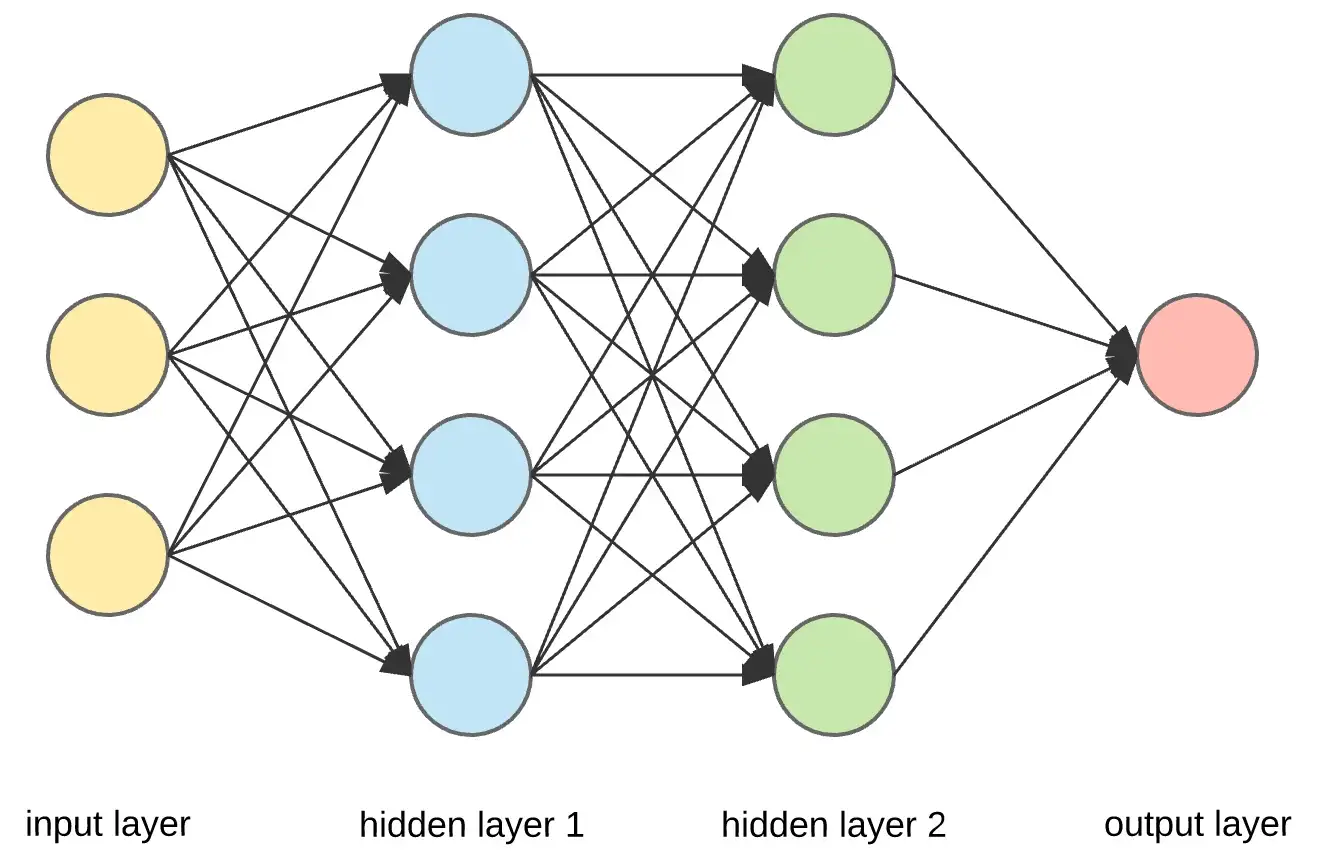
$$\textbf{out}_1 = f(\textbf{x}\cdot\textbf{W}_1)$$
$$\textbf{out}_2 = f(\textbf{out}_1\cdot\textbf{W}_2)$$
$$\textbf{y} = f(\textbf{out}_2\cdot\textbf{W}_3)$$
$$\textbf{y} = f(f(f(\textbf{x}\cdot\textbf{W}_1)\cdot\textbf{W}_2)\cdot\textbf{W}_3)$$
Aktivierungsfunktion
$$f_1(x) = k_1x + d_1, f_2(x) = k_2x + d_2$$
$$f_1(f_2(x)) = k_1f_2(x) + d_1 = k_1(k_2x + d_2) + d_1$$
$$f_1(f_2(x)) = k_1k_2x + k_1d_2 + d_1$$
$$f_1(f_2(x)) = \underbrace{k_1k_2}\textrm{k}x + \underbrace{k_1d_2 + d_1}\textrm{d}$$
Ohne Aktivierungsfunktionen nur lineare Zusammenhänge
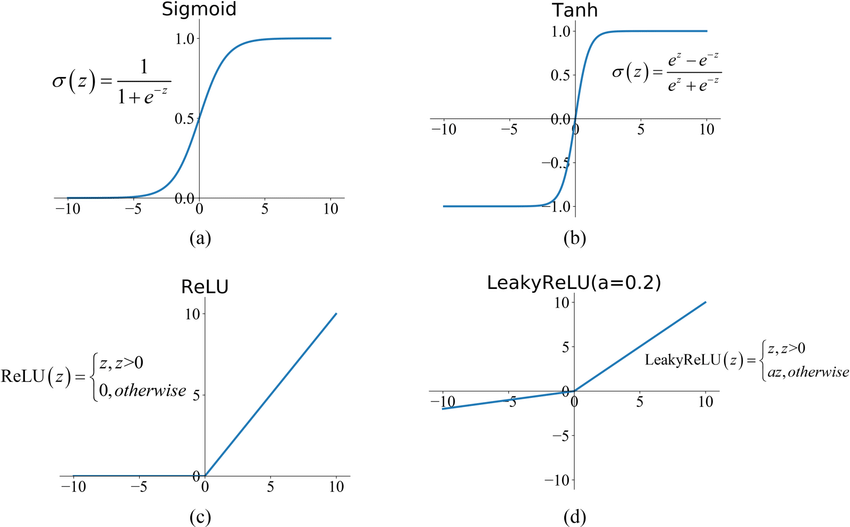
Auswahl
- Hidden Layer: *elu
- Output layer
- Regression
- Keine $\rightarrow y=x$
- Loss:
MSELoss()
Klassifikation
Logits ⟹ Probabilities ⟹ Classes
- Binäre Klassifikation
Sigmoid()/BCELoss()- keine /
BCEWithLogitsLoss() -
Linear(in_features=42, out_features=2) Softmax(dim=1) - Multi-class-classification
- keine /
CrossEntropyLoss() Softmax()/CrossEntropyLoss()-
Linear(in_features=42, out_features=class_count)
Softmax(dim=1)
Training
- Alle $w_i$ random initialisieren
- forward pass:
Observation -> Output
- Loss $L(y_{true}, y_{pred})$ berechnen
- backward pass/backpropagation:
$w_i$ anpassen vom output-Layer bis zum input-Layer
for X, y in data:
  prediction = model(X)
  error = loss_fn(y, prediction)
  update_weights(error, loss)
Forward pass
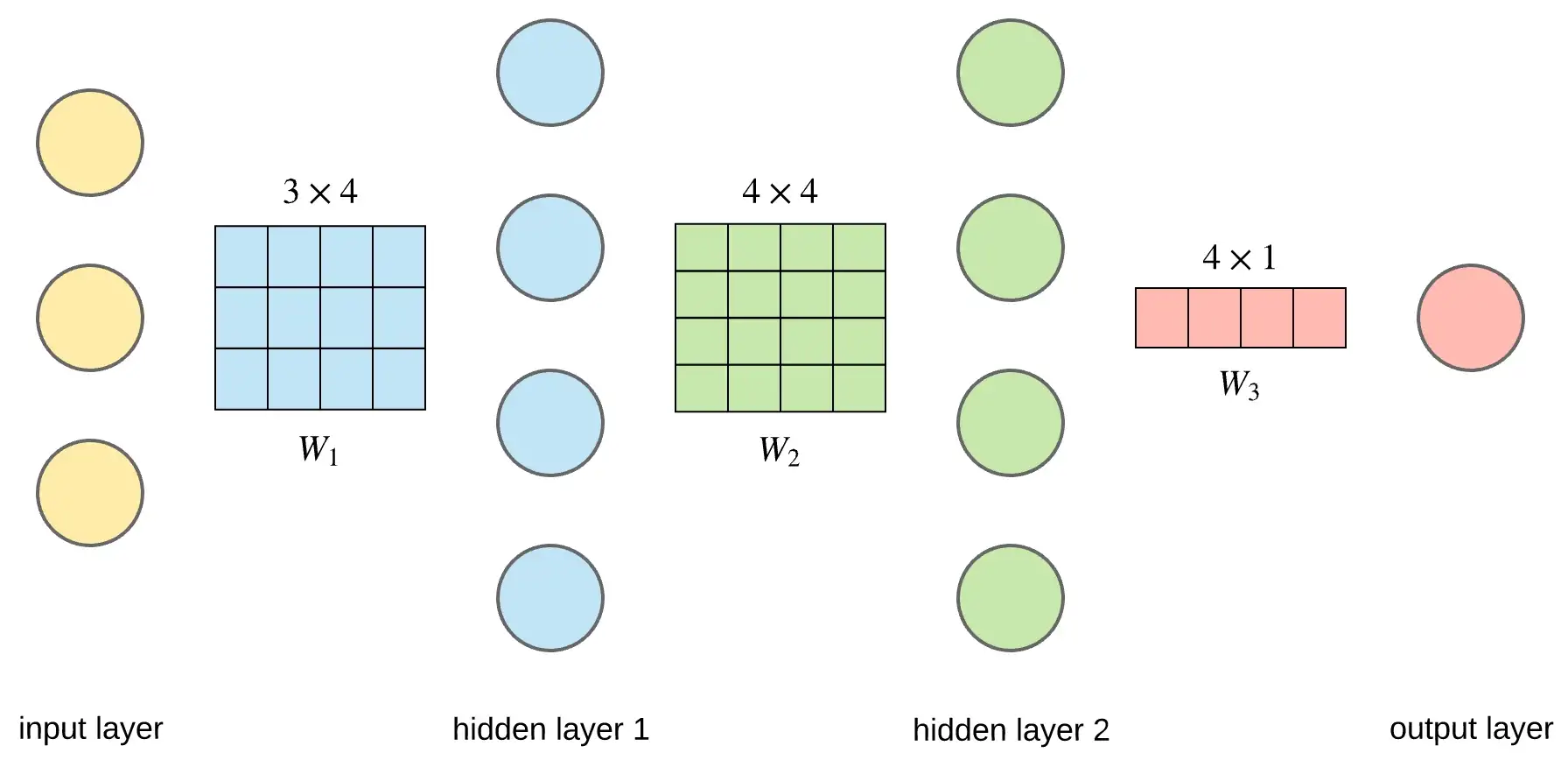
$$ 1 \times 3 \cdot 3 \times 4 = 1 \times 4$$
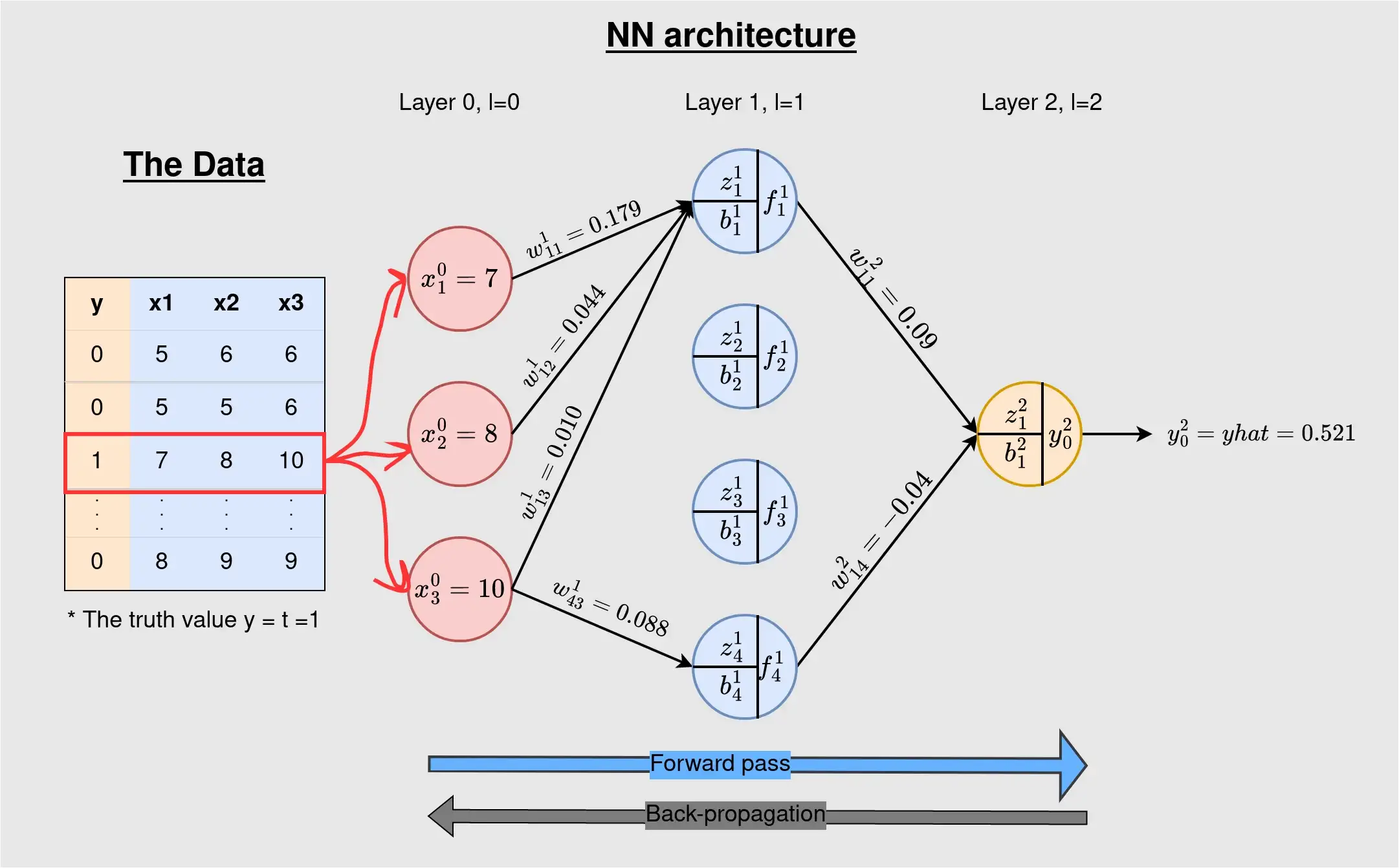
Backward pass
- $L(y_{true}, y_{pred}),\qquad y_{pred}(\textbf{x}, \textbf{w})$
- $\implies L(y_{true}, \textbf{x}, \textbf{w})$
- $\implies$ Anpassen der weights $\textbf{w}$, sodass Fehler $L$ minimal
Gradient Descent

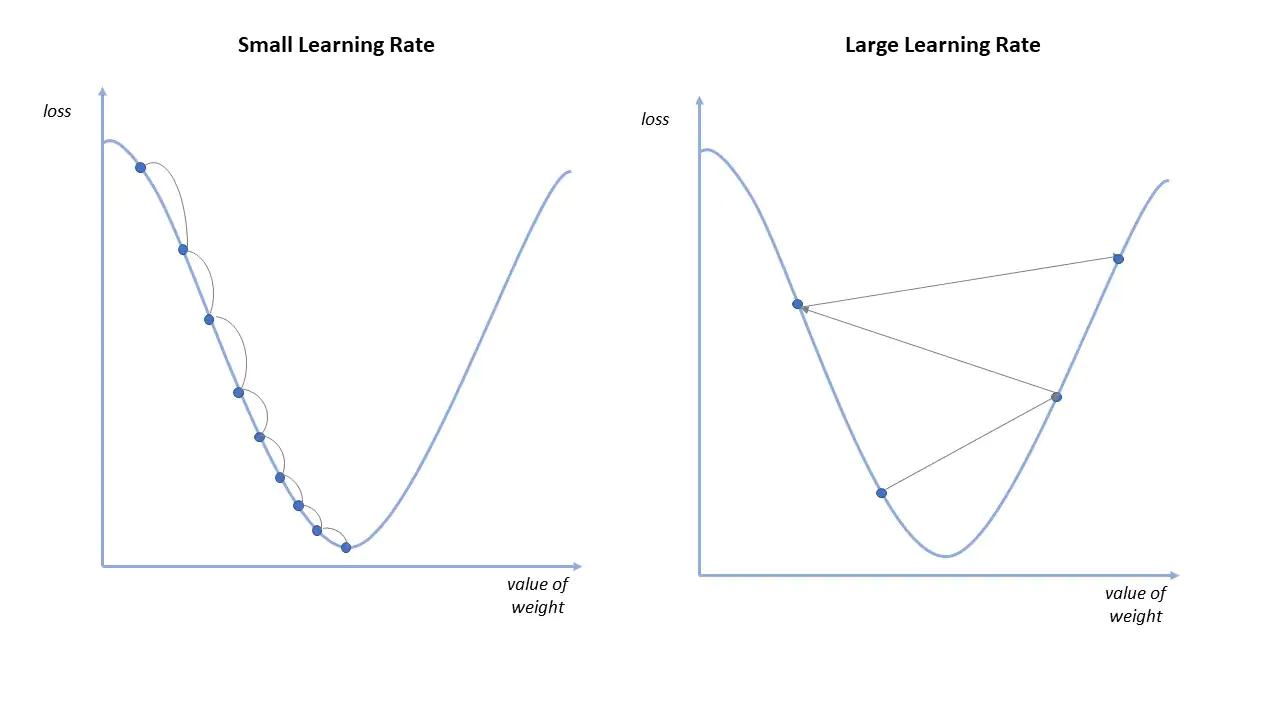
Learning rate
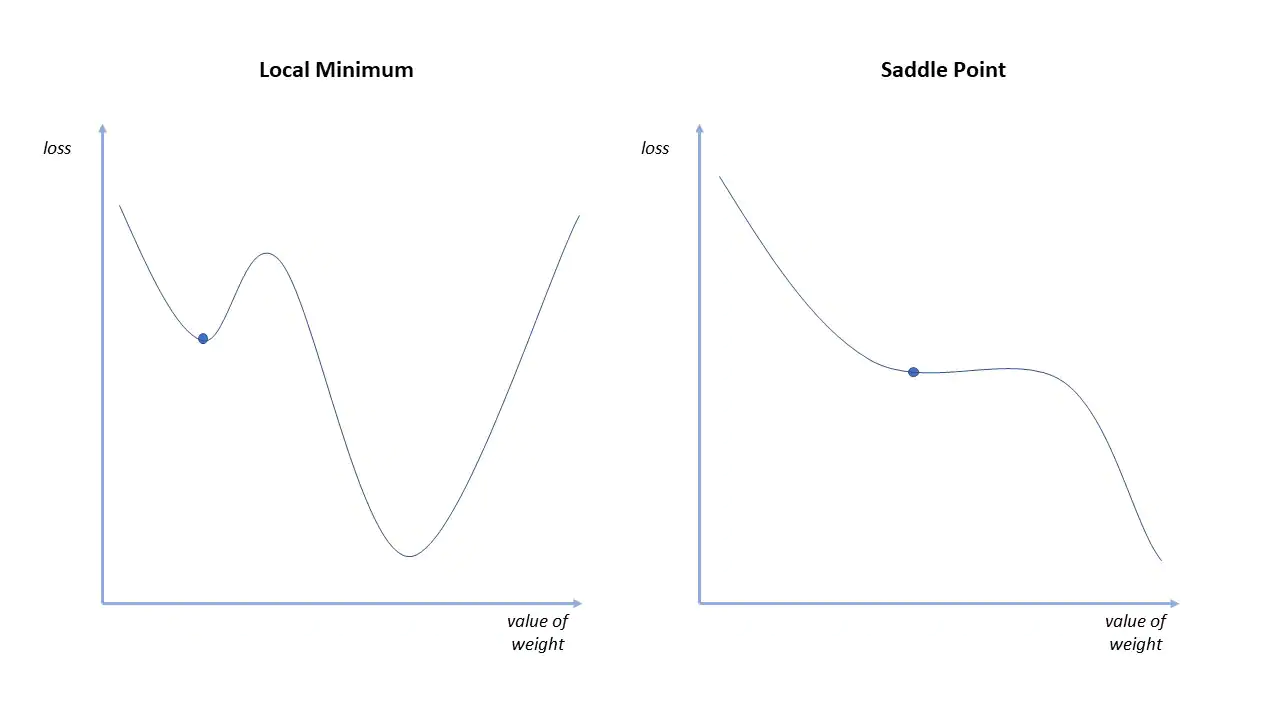
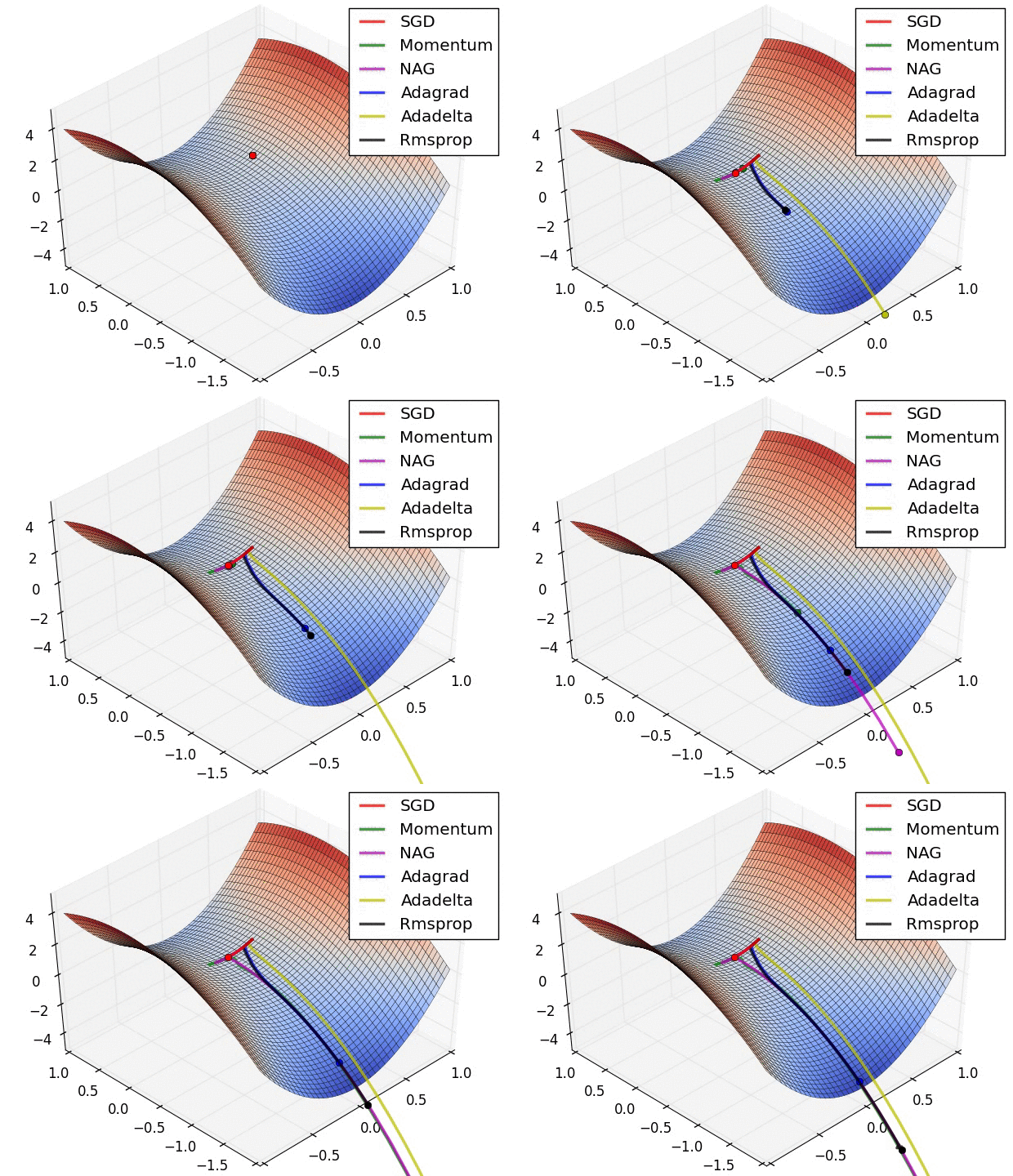
Probleme
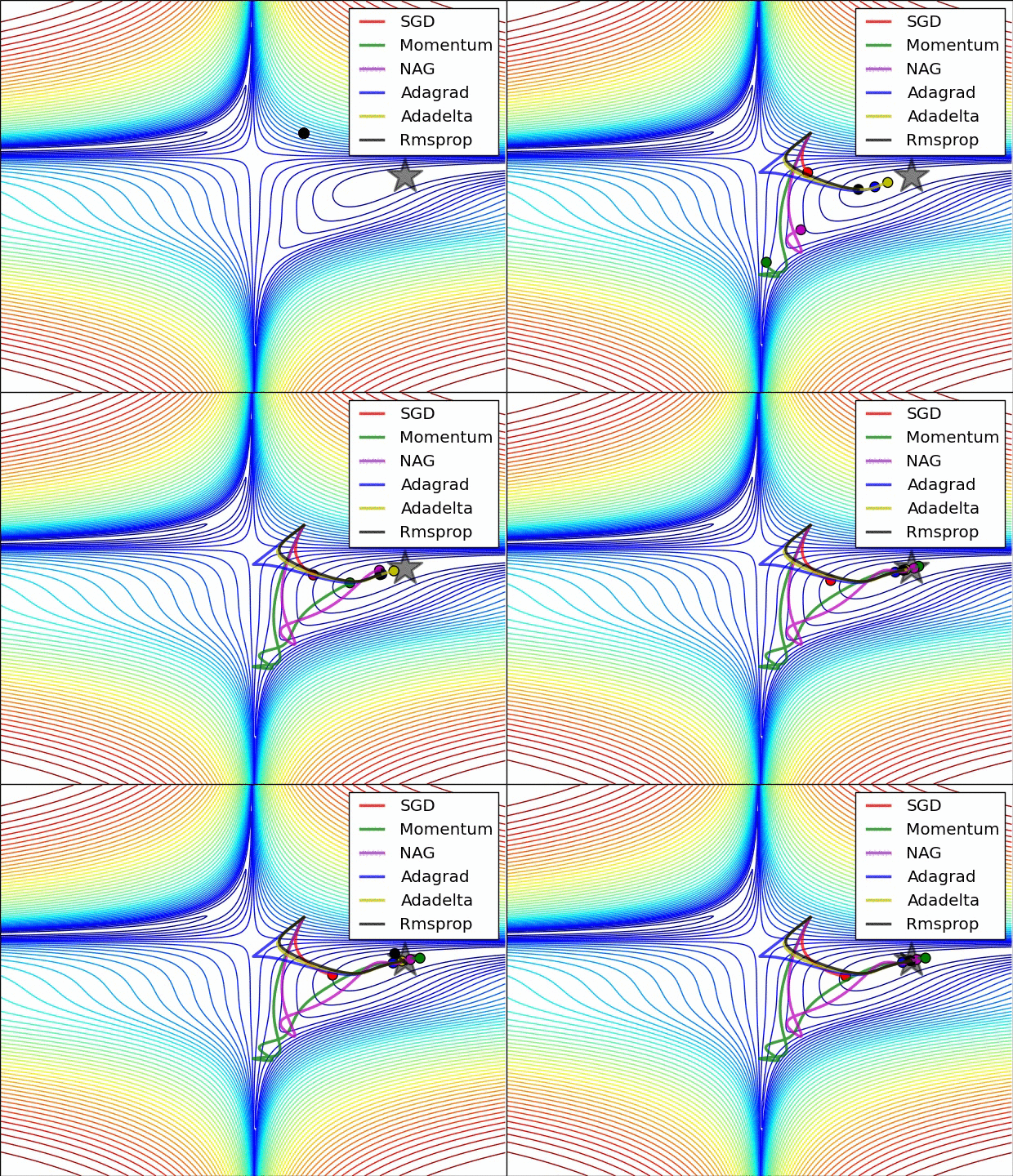
Momentum
Backpropagation
$$w_{t+1} = w_t - \eta\frac{\partial L}{\partial w_t}$$ $\eta\dots $ learning rate
Kettenregel
$$y = f(u), u = g(x)) \implies y=f(g(x))$$
$$\implies y' = f(g(x))'= f'(g) \cdot g'(x)$$
$$y = sin(x^2) \implies y' = cos(x^2) \cdot 2x$$
$$\frac{dy}{dx} = \frac{dy}{du}\frac{du}{dx}$$

$$\frac{\partial L}{\partial w^2_{11}} = \frac{\partial L}{\partial \hat{y}} \frac{\partial \hat{y}}{\partial z_1^2} \frac{\partial z_1^2}{\partial w^2_{11}}$$
\begin{align} \frac{\partial z_1^2}{\partial w^2_{11}} = &\frac{\partial}{\partial w^2_{11}}(f_1^1 w^2_{11} + f_2^1 w^2_{12} + f_3^1 w^2_{13} + f_4^1 w^2_{14} + b_1^2)\\ = &f_1^1 \end{align}
$\hat{y}(z) = \frac{1}{1+e^{-z}}$ aka sigmoid, $\hat{y}(z)' = \dots$
$$\frac{\partial L}{\partial w^2_{11}} = -0.405$$
Adam - Adaptive Moment Estimation
optimizer = Adam(model.parameters(), lr=1e-3)- für jedes $w$ werden die letzten Änderungen ausgewertet
- und diese in die Backpropagation einbezogen
batch_size
Bei jeder observation weights updaten problematisch:
- viel Aufwand
- ständig auf/ab
- 💡 ein paar processen, Fehler mitteln
for X, y in data:
  # X.shape[0] = batch_size
  predictions = model(X) # shape = (batch_size, 1)
  error = loss_fn(y, prediction) # shape = (batch_size, 1)
  total_error = error.sum() # shape = (1, 1)
  optimizer.update_weights()