Collections
Motivation
- Massendatenverarbeitung
- Arrays nicht erweiterbar
Vererbungshierarchie
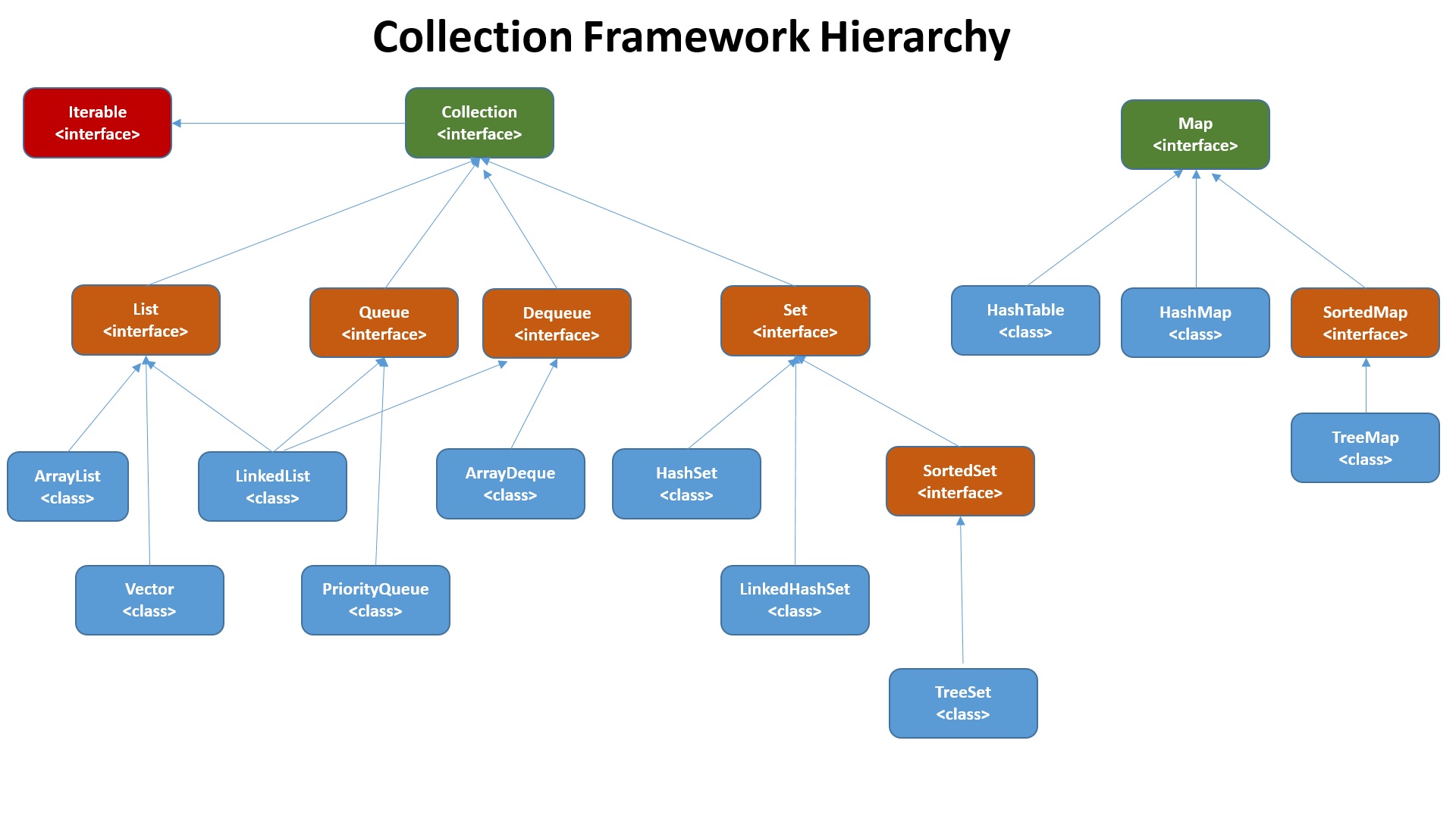
Collection<T>
public interface Collection<E> extends Iterable<E> {

    int size();
    boolean isEmpty();
    boolean contains(Object o);
    Iterator<E> iterator();
    Object[] toArray();
    <T> T[] toArray(T[] a);
    boolean add(E e);
    boolean remove(Object o);
    boolean containsAll(Collection<?> c);
    boolean addAll(Collection<? extends E> c);
    boolean removeAll(Collection<?> c);
    boolean retainAll(Collection<?> c);   // getSharedElements
    void clear();
    boolean equals(Object o);
    int hashCode();
}
boolean returnwert ⟹ hat sich Collection geändert
Konstruktoren
jede Collection hat zumindest 2 Konstruktoren:
public CollectionImpl()- erzeugt eine leere Collection
public CollectionImpl(Collection c)- erzeugt eine neue Collection, welche alle Elemente der übergebenen enthält
List<Integer> original = new ArrayList<>();
original.add(10);
original.add(20);
original.add(30);
List<Integer> copy = new ArrayList<>(original);
original.set(1, 42);
original: [10, 42, 30]
copy: [10, 20, 30]List<E>
- Indexbasierter Zugriff
- nicht sortiert, aber sortierbar
- geordnet: Zuletzt eingefügtes Element am Ende
public interface List<E> extends Collection<E> {

    E get(int index);
    E set(int index, E element);
    void add(int index, E element);
    E remove(int index);
    int indexOf(Object o);
    int lastIndexOf(Object o);
    ListIterator<E> listIterator();
    default void sort(Comparator<? super E> c) { ... }
    List<E> subList(int fromIndex, int toIndex);
}Implementierungen
ArrayList- Liste wird durch Array realisiert.
Bei Bedarf wird das Array vergrößert LinkedList- Wie in 2.Klasse implementiert

List<String> words = new ArrayList<>();
words.add("Apfel");
words.add("Biene");
words.add("Honig");
[Apfel, Biene, Honig]words.add(1, "Imker");[Apfel, Imker, Biene, Honig]for (String word : words)
word.toUpperCase();Collections.sort(words);
words.sort(null);[Apfel, Biene, Honig, Imker]Set<T>
- enthält nur unique Elemente
- keine neuen Methoden
Implementierungen
HashSet- verwendet einen Hashtable; schnell
TreeSet- speichert Elemente sortiert; langsam
LinkedHashSet- verwendet zusätzlich eine
LinkedList
⟹ geordnet; mittelschnell
Collection<Integer> set = new HashSet<>();
set.add(404);
set.add(201);
set.add(-37);
set.add(-37);
[404, -37, 201]Collection<String> set = new TreeSet<>();
set.add("POS");
set.add("AM");
set.add("NVS");[AM, NVS, POS]Collection<String> set = new LinkedHashSet<>();
set.add("POS");
set.add("AM");
set.add("NVS");[POS, AM, NVS]Problem
public class Dog {
    private String name;

    public Dog(String name) {
        this.name = name;
    }
}
Collection<Dog> dogs = new HashSet<>();
dogs.add(new Dog("Ecco"));
dogs.add(new Dog("Ecco"));
int size = dogs.size();2Hashing
Set<User> users = getAllUsers();
User user = new User(input);
if (users.contains(user))
...==usermuss exakt dasselbe Objekt wie im Set seinequalsUserhat 7 Instanzvariablen ⟹ langsam- Hashing
user.hashCode()wird berechnet- hat ein Element in
usersden gleichen Hashcode - könnte es das richtige sein ⟹ jetzt
equals
Kollisionen
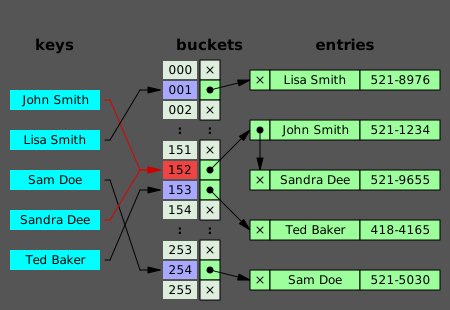
- John Smith und Sandra Dee haben gleichen hash
- Wird nun Sandra Dee gesucht, so wird nur in Bucket 152 gesucht
Beispiel
class Student {

    private int katalognummer;
    private String name;

    public int hashCode() {
        return katalognummer;
    }
}- gleiche KatNr ⟹ vielleicht gleiche Schüler
- andere KatNr ⟹ unterschiedliche Schüler
- gleiche Schüler ⟹ gleiche KatNr
- unterschiedliche Schüler ⟹
hashCode / equals - Contract
a.hashCode() == b.hashCode()- Objekte vielleicht
equal a.hashCode() != b.hashCode()- Objekte unterschiedlich
a.equals(b)a.hashCode() == b.hashCode()!a.equals(b)a != b
Mutablity
Collection<Dog> dogs = new HashSet<>();
Dog ecco = new Dog("Ecco")
dogs.add(ecco);
dogs.add(new Dog("Snoopy"));
ecco.setName("Snoopy");
⚠️ Set korrupt ⚠️
Daten in einem Set sollten immutable sein
- wie
String - Instanzvariable
private final setterreturnen neue Objekte
TreeSet<T>
public class Student {

    private String name;
    private int id;

    public Student(String name, int id) {
        this.name = name;
        this.id = id;
    }
}
Set<Student> students = new TreeSet<>();
Student student = new Student("Alfred", 1);
students.add(student);java.lang.ClassCastException:
class Student cannot be cast to class java.lang.ComparableComparable<T>
public interface Comparable<T> {
    /**
    *   this < o  ==> < 0
    *   this == o ==>  0
    *   this > o  ==> > 0
    */
    public int compareTo(T o);
}- definiert eine natural order
- beim Einfügen in ein
TreeSetgecalled - beim Sortieren einer
List/ eines Arrays gecalled
Implementierung
public class Student implements Comparable<Student>{

    @Override
    public int compareTo(Student o) {
        int result = Integer.compare(id, o.id);
        if (result != 0)
            return result;
        return name.compareTo(o.name);
    }
Set<Student> students = new TreeSet<>();
students.add(new Student("Alfred", 1));
students.add(new Student("Bernd", 2));
students.add(new Student("Agatha", 1));[{Agatha, id=1}, {Alfred, id=1}, {Bernd, id=2}]public int compareTo(Student o) {
return Comparator.comparingInt(Student::getId)
.thenComparing(Student::getName)
.compare(this, o);
}NavigableSet<T>
public interface NavigableSet<E> extends SortedSet<E> {

    E lower(E e);   // returnt < e
    E floor(E e);   // returnt <=e
    E ceiling(E e); // returnt >=e
    E higher(E e);  // returnt > e
    E pollFirst();  // return min
    E pollLast();   // return max
    SortedSet<E> subSet(E fromElement, E toElement);    // from < all < to
    SortedSet<E> headSet(E toElement);      // min < all < to
    SortedSet<E> tailSet(E fromElement);    // from <= all < max
}
Ermöglicht äquivalent zu SQL die höchsten / niedrigsten Werte zu selektieren
Comparator<T>
public interface Comparator<T> {

    /**
    *   o1 < o2  ==> < 0
    *   o1 == o2 ==>  0
    *   o1 > o2  ==> > 0
    */
    int compare(T o1, T o2);
}- OO - Repräsentation von Sortierregeln
- zum Überschreiben der natural Order
- oder falls keine vorhanden ist
Anwendung
List<String> caesars =
        Arrays.asList("Cäsar", "Augustus", "Justinian", "Nero");
[Cäsar, Augustus, Justinian, Nero]Collections.sort(caesars);[Augustus, Cäsar, Justinian, Nero]Comparator<String> byLength = new Comparator<>() {
@Override
public int compare(String o1, String o2) {
return Integer.compare(o1.length(), o2.length());
}
};
caesars.sort(byLength);
System.out.println(caesars);[Nero, Cäsar, Augustus, Justinian]Map / Dictionary / Assoziatives Array
🐍
dictionary = {'POS': 'SCRE', 'AM': 'RIEE', 'E': 'NEUL'}
dicionary['POS'] # -> 'SCRE'array["POS"]🚫 incompatible types: java.lang.String cannot be converted to intmap.put("POS", "SCRE");
map.get("POS") -> "SCRE"Speichern von key / value - Paaren
Map<K, V>
public interface Map<K, V> {

    int size();
    boolean isEmpty();
    boolean containsKey(Object key);
    boolean containsValue(Object value);
    V get(Object key);
    V put(K key, V value);
    V remove(Object key);
    void putAll(Map<? extends K, ? extends V> m);
    void clear();
    Set<K> keySet();
    Collection<V> values();
    Set<Map.Entry<K, V>> entrySet();
    default V getOrDefault(Object key, V defaultValue) { ... }
    default V putIfAbsent(K key, V value) { ... }
}
Implementierungen
HashMap- Keys werden in einem
HashSetgespeichert TreeMap- Keys werden in einem
TreeSetgespeichert LinkedHashMap- Keys werden in einem
LinkedHashSetgespeichert
Iterieren
Set<K> keySet()- Liefert alle keys
Collection<V> values()- Liefert alle values
Set<Map.Entry<K, V>> entrySet()- Liefert alle key / value - Paare
Wichtige Methoden
if (map.contains(key))
    result = map.get(key);
else
    result = defaultValue;
return map.getOrDefault(key, defaultValue);if (!map.contains(key))
map.put(key, newValue);map.putIfAbsent(key, newValue);Queue<T>
- Warteschlange, FIFO (oder FILO)
- Teilweise mit beschränkter Kapazität
public interface Queue<E> extends Collection<E> {

    boolean add(E e);       // full  -> Exception
    boolean offer(E e);     // full  -> false
    E remove();             // empty -> Exception
    E poll();               // empty -> null
    E element();            // empty -> Exception
    E peek();               // empty -> null
}
PriorityQueue<T>
remove/poll entfernt immer Minimum
Queue<String> queue = new PriorityQueue<>();
queue.add("NVS");
queue.add("AM");
queue.add("D");
queue.add("POS");
System.out.println(queue);
⚠️ [AM, NVS, D, POS] ⚠️StringJoiner joined = new StringJoiner(", ");
while(!queue.isEmpty())
joined.add(queue.remove());
System.out.println(joined);AM, D, NVS, POS