JPA
Java Persistence API
Probleme mit JDBC
CRUD-Operationen boilerplate
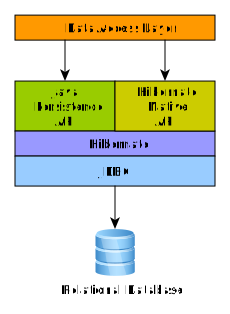
Architektur
Persistence Unit
resources/META-INF/persistence.xml
<persistence-unit name ="at.htlstp.jpa.library" >
<class > domain.Entity</class >
<properties >
<property name ="jakarta.persistence.jdbc.driver"
value ="org.h2.Driver" />
<property name ="jakarta.persistence.jdbc.url"
value ="jdbc:h2:mem:bibliothek" />
<property name ="hibernate.dialect"
value ="org.hibernate.dialect.H2Dialect" />
<property name ="hibernate.show_sql" value ="true" />
<property name ="hibernate.format_sql" value ="true" />
<property name ="hibernate.hbm2ddl.auto" value ="update" />
</properties >
</persistence-unit > hibernate.hbm2ddl.auto
none
default
create-only
Erzeugt create-Statements
drop
create
drop, dann create-only
create-drop
drop, dann create-only, finally drop
validate
update
Entities
@Entity
@Table(name = "defaulting_to_classname")
public class Customer implements Serializable {
    @Id
    @GeneratedValue
    private Integer id;

    @NotNull
    private String name;

    @NaturalId
    private String email;
}
create table defaulting_to_classname (
id integer not null ,
email varchar (255 ),
name varchar (255 ) not null ,
primary key (id))
alter table defaulting_to_classname
add constraint UK_ruvgttp unique (email)Generation Strategies
@Id
private Long assignedByJava;
@Id
@GeneratedValue
private Integer databaseDefaultStrategy;@Id
@GeneratedValue(strategy = GenerationType.IDENTITY)
private Long assignedByTableColumn;@Id
@GeneratedValue(
strategy = GenerationType.SEQUENCE,
generator = "customer_generator")
@SequenceGenerator(
name = "customer_generator",
sequenceName = "customer_sequence")
private Short assignedByOwnSequence;Annotations
@Column(
    name = "columnName",
    unique = true,
    length = 10)
private String javaName;
create table Customer (
id integer not null ,
columnName varchar (10 ),
primary key (id))
alter table Customer
add constraint UK_5ru7su37v unique (columnName)@ElementCollection
private Collection<String> aliases;create table Customer_aliases (
Customer_id integer not null ,
aliases varchar (255 ))@Entity
public class Customer @Id
private Short id;
@Transient
private String notForDb;
}create table Customer (
id smallint not null ,
primary key (id))@Entity
@Check(constraints = """
CASE
WHEN name IS NOT NULL THEN LENGTH(name) > 3
ELSE true
END""")
public class Customer {jakarta.validation@NotNull
@Size(max = 100)
@Email
private String email;@PositiveOrZero
private int age;@ElementCollection
@Size(min = 1, max = 5)
private Collection<String> aliases;@Past
private LocalDate dateOfBirth;@Pattern("^(?:[0-9]{1,3}\.){3}[0-9]{1,3}$")
private String ip;@AssertTrue
public boolean isBeginningBeforeEnd () {
return beginning.isBefore(end);
}Dependencies
<dependencies >
<dependency >
<groupId > org.hibernate.validator</groupId >
<artifactId > hibernate-validator</artifactId >
<version > 7.0.4.Final</version >
</dependency >
<dependency >
<groupId > org.glassfish</groupId >
<artifactId > jakarta.el</artifactId >
<version > 4.0.1</version >
</dependency >
</dependencies > EntityManagervar factory = Persistence
.createEntityManagerFactory("at.htlstp.jpa.library" );
var entityManager = factory.createEntityManager();
Verwaltet Entitäten in einem Persistence Context
Am besten in try-with
Schreibende Db-Operationen nur in Transaktion
Verwendung
var factory = Persistence
.createEntityManagerFactory("at.htlstp.jpa.library" );
try (var entityManager = factory.createEntityManager()) {
var transaction = entityManager.getTransaction();
transaction.begin();
entityManager.persist(customer);
transaction.commit();
} catch (RuntimeException ex) {
if (transaction.isActive())
transaction.rollback();
throw ex;
}States
transient Objekt war nie managed
managed /persistent entityManager.flush() -> DbUpdate
detached Objekt war managed
Methoden
persist(entity)find(entityClass, pk)remove(entity)
merge(entity)
lädt entity in den Context
updated entity im Context mit übergebener
find(entityClass, entity.pk)persist(entity)
returnt die Entity aus dem Context
equals/hashCodeBeziehungen
Generell
nur der Owner darf in Db schreibenLazy Loading
@Basic(fetch = FetchType.EAGER)
private String alwaysLoaded
private String defaultEager;@Basic(fetch = FetchType.LAZY)
private String loadedIfNeeded;
Performance
lazy detached -> Exception 💥
Fix: select ... join fetch lazyField
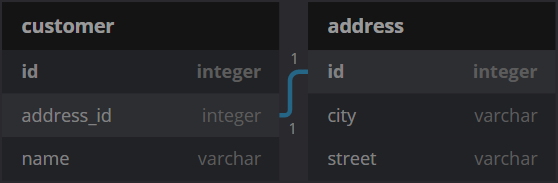
@OneToOneEach customer has one address
@Entity
public class Customer {
   @OneToOne(fetch = FetchType.EAGER)                 // default
   @JoinColumn(unique = true, name = "address_id")    // default
   private Address address;
@Entity
public class Address {
   @OneToOne(mappedBy = "address")   // der Variablenname im Owner
   private Customer resident;        // entfernen -> unidirektional
Anwendung
Besser über @Embeddable, außer
Entity auch an anderer Stelle verwendet
Daten aus unterschiedlichen Dbs
@OneToMany/@ManyToOne
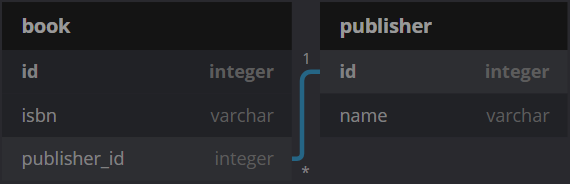
Each publisher publishes many books.
Each book has one publisher
@Entity
public class Book {
@ManyToOne(fetch = FetchType.EAGER)
@JoinColumn(unique = false)
private Publisher publisher;@Entity
public class Publisher {
@OneToMany(
mappedBy = "publisher",
fetch = FetchType.LAZY)
private Collection<Book> books = new HashSet <>();@ManyToMany
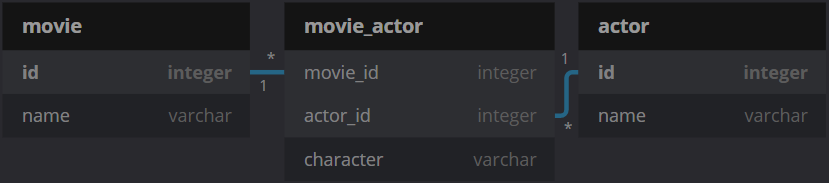
Each movie has many actors in it
Each actor stars in many movies
@Entity
public class Movie {
    @ManyToMany
    @JoinTable(name = "movie_actor",
            joinColumns = @JoinColumn(name = "movie_id"),
            inverseJoinColumns = @JoinColumn(name = "actor_id"))
@Entity
public class Movie {
@ManyToMany(fetch = FetchType.LAZY)
private Collection<Actor> actors = new HashSet <>();
public Collection<Actor> getActors () {
return actors;
}@Entity
public class Actor {
@ManyToMany(
mappedBy = "actors",
fetch = FetchType.LAZY)
private Collection<Movie> movies = new HashSet <>();
public Stream<Movie> getMovies () {
return movies.stream();
}
public void starInMovie (Movie movie) {
movie.getActors().add(this );
movies.add(movie);
}Owning
public class Movie {
@ManyToMany
private Collection<Actor> actors = new HashSet <>();
...
}
public class Actor {
@ManyToMany(mappedBy = "actors")
private Collection<Movie> movies = new HashSet <>();
...
}entityManager.merge(movie);
entityManager.remove(movie); Movie gelöscht, Actor existiert
entityManager.merge(actor);
entityManager.remove(actor);
💥 Referential int egrity constraint violation@PreRemove
public class Actor {
@ManyToMany(mappedBy = "actors")
private Collection<Movie> movies = new HashSet <>();
@PreRemove
void removeFromAllMovies () {
movies.forEach(movie -> movie.getActors().remove(this ));
}
...
}entityManager.merge(actor);
entityManager.remove(actor); Actor gelöscht, kommt in keinem Movie mehr vor
JoinTable mit Extras
Nur mapbar über eigene Entity
@Entity
public class Character {

  @ManyToOne
  private Actor actor;

  @ManyToOne
  private Movie movie;

  @Column(name = "character")
  private String name;
Cascade
@Entity
public class A {
    @OneToOne(cascade = CascadeType.ALL, orphanRemoval = true)
    private B b;
Attribut bei @XtoY
CascadeType.{PERSIST, MERGE, REMOVE, ALL}
CascadeType.OPem.op(a); -> em.op(b);
orphanRemovala.setB(otherB);-> em.remove(b);
Deletion
@Entity
public class Order { ... }
entityManager.remove(order); @Entity
@SoftDelete
public class Order { }
entityManager.remove(orderWithId42);
id
customer
deleted
41
575
false
42
1243
true
43
1243
false
JPQL
Eigenschaften
SQL-ähnliche objektorientierte Abfragesprache
Bezeichner aus Java, keine Tables
Anwendung ausschließlich auf Entities
Ausführung
var query = entityManager.createQuery("""
select address from Address address""" ,
Address.class);
List<Address> addresses = query.getResultList();query = entityManager.createQuery("""
select address
from Address address
where address.id = 1""" , Address.class);
Address address = query.getSingleResult();
List<Object > addresses = entityManager.createQuery("""
select address
from Address address
where address.city = :city""")
.setParameter("city", "St. Pölten")
.getResultList();
Select
List<Object[] > result = entityManager.createQuery("""
select address.city, address.street, address.zip
from Address address""")
.getResultList();
result.stream()
.map(Arrays::toString)
.forEach(System.out::println);
[St. Pölten, Waldstraße 7 , 3100 ]
[Wien, Antonigasse 13 , 1180 ]
[Wien, Michaelerkuppel 10 , 1010 ]
[Wien, Wienerbergerstraße 1 , 1120 ]
[St. Pölten, Schießstattring 6 , 3100 ]
[Wilhelmsburg, Obere Hauptstraße 42 , 3150 ]
[St. Pölten, Rathausplatz 2 , 3100 ]
[St. Pölten, Rathausplatz 3 , 3100 ]where
select book.id, book.title
from Book book
where book.title = :title
≈ select new Book(book.id, book.title)
from Book book
where book.title = :title
select distinct customer.lastname
from Customer customer
select book
from Book book
where book.publisher.name like '% HALL'
select book
from Book book
order by book.author, book.title desc
select publisher.name, book
from Publisher publisher, Book book
where publisher = book.publisher
= select publisher.name, book from Publisher publisher
join publisher.books book
select publisher
from Publisher publisher
join publisher.books book
where book.title like :title
select book
from Book book
where book.author is null
or book.id <= 1 and book.publisher.name not like '% HALL'
Collections
Collection<Book> books = em
        .createQuery("""
            select publisher.books
            from Publisher publisher""")
        .getResultList();
select book
from Book book
where book.isbn in ('404', '418')
select book
from Book book
where book.isbn in :javaCollection
select book
from Book book
where book.id between 1 and 3
select publisher
from Publisher publisher
where publisher.books is empty
select publisher
from Publisher publisher
where size(publisher.addresses) >= 3
select address
from Address address, Publisher publisher
where address.city = 'St. Pölten'
alle Adressen in StP für alle Publisher
select address
from Address address, Publisher publisher
where address.city = 'St. Pölten'
and address member of publisher.addresses
groupBy
List<Object[]> result = entityManager.createQuery("""
select book.publisher.name, count(book)
from Book book
group by book.publisher.name
having count(book) > 0
order by book.publisher.name""")
.getResultList();
Map<String, Long> map = result.stream()
.collect(toMap(
record -> (String) record[0],
record -> (Long) record[1],
Long::sum, // mergeFunction
LinkedHashMap ::new));
Aggregatfunktionen
select count (*)
from Book -> long
select oldest
from Book oldest
where oldest.publicationDate =
(select min (b.publicationDate)
from Book b)
sum() -> long/doubleavg() -> double
Funktionen
upper/lower(String s)current_date/time/timestamp()substring(String s, int offset, int length)trim(String s)length(String s)abs(Numeric n)sqrt(Numeric n)mod(Numeric a, Numeric b)
Embeddables
@Entity
public class Customer {
    @EmbeddedId
    private Uid uid;

    @Embedded
    private Address address;
}
@Embeddable
public class Uid implements Serializable {
private String email;
}create table Customer (
email varchar (255 ) not null ,
street varchar (255 ),
zip integer ,
primary key (email))concatenated keys
Wie kommt das SQL zustande?
String, Integer etc. kein Table. Addressist ebenso@Embeddable`, siehe SQL
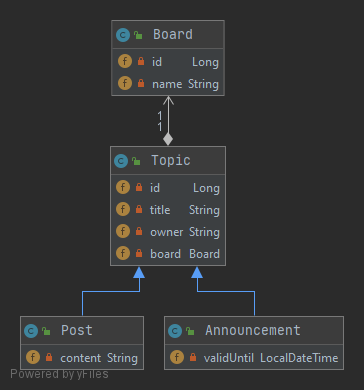
Vererbung
ein Table mit einer Laufzeittyp-Columnein Table je Klasse, wobei ein fk zur Basisklasse besteht, wo die vererbten Daten sind
@Entity
@Inheritance
public class Topic {
    @Id
    @GeneratedValue
    private Long id;
@Entity
public class Post extends Topic {
private String content;
}@Entity
public class Announcement extends Topic {
@NotNull
private LocalDateTime validUntil;
}Table Topic(Auszug)
DTYPE
OWNER
VALIDUNTIL
CONTENT
Post
owner
NULL
content
Announcement
owner
2020-04-21 20:39:37.292626
NULL
Post
SCRE
NULL
ok
Post
SCRE
NULL
thx
Announcement
CNN
2020-04-21 20:39:37.292626
NULL